
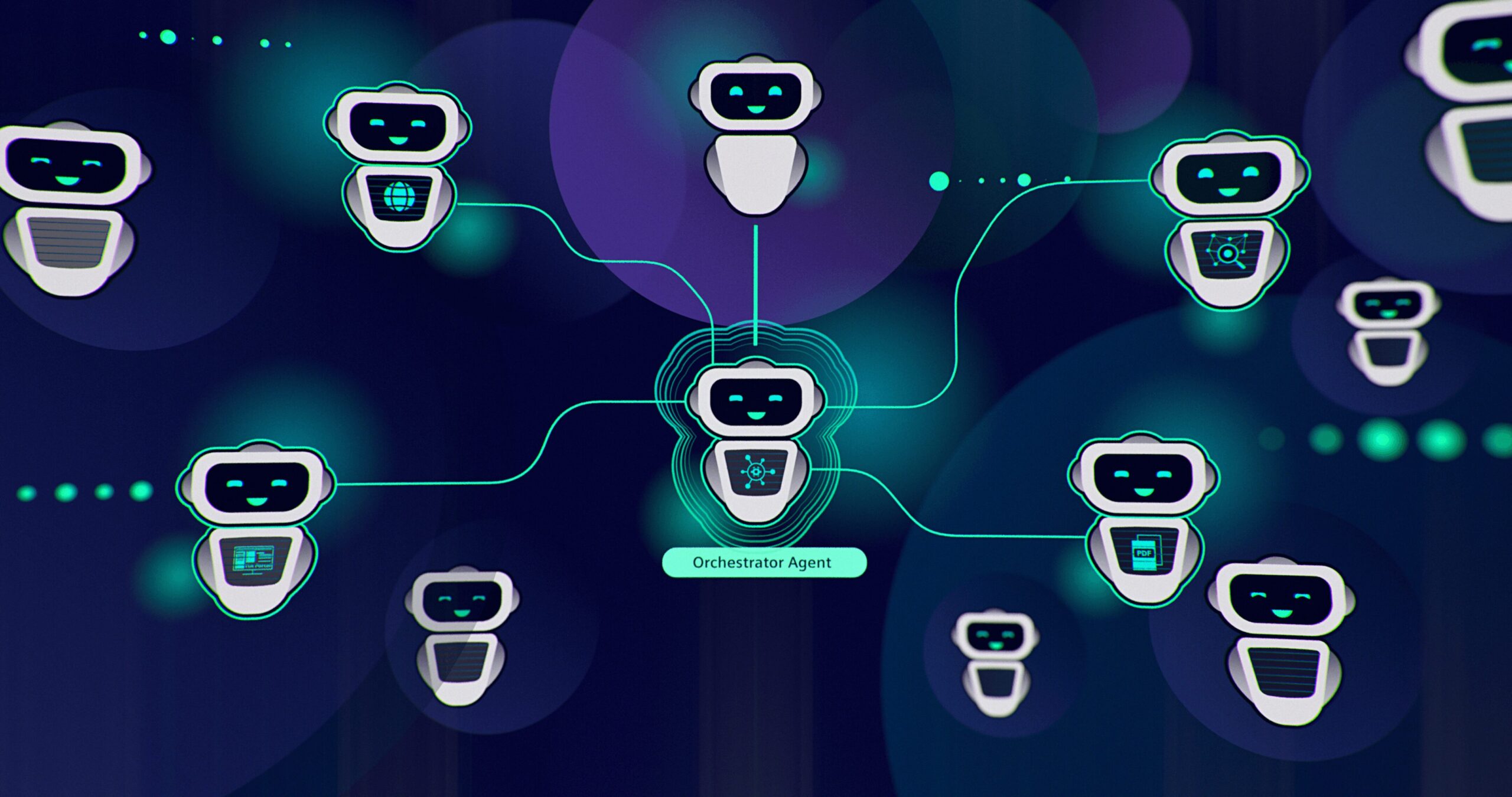
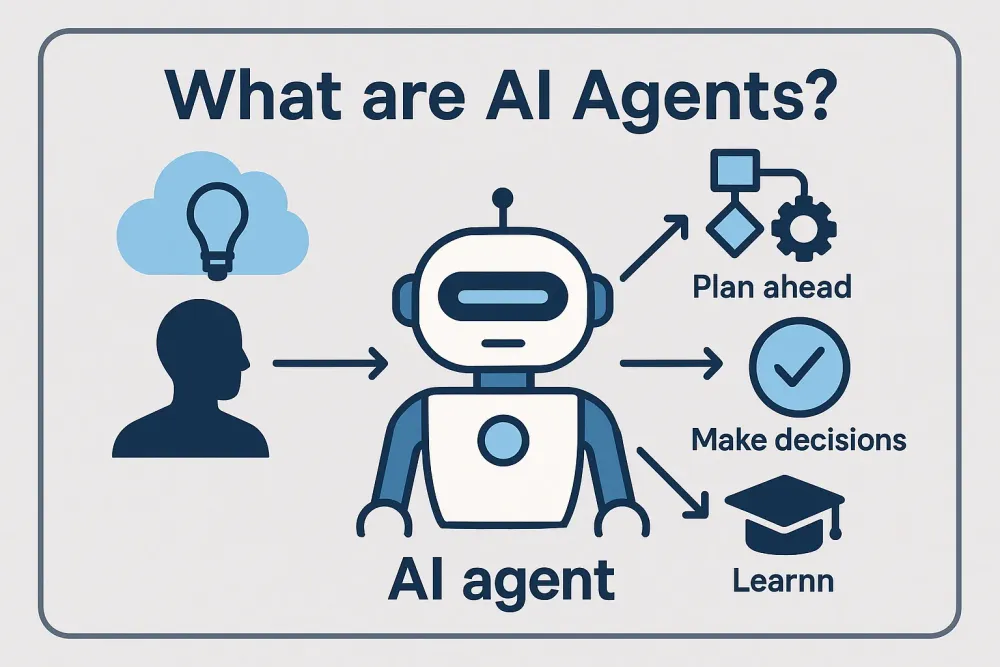
An AI agent is a piece of software that can understand a goal, decide what to do, and then take actions on its own to reach that goal, instead of just answering questions one by one. Think of it as an intelligent digital coworker that can plan, use tools, and learn from experience—not just a chatbot that replies to messages.
Short answer: what is an AI agent explained simply?
In simple terms, an AI agent is:
A software program that observes what’s going on, decides what to do, and then acts by itself to achieve a goal you set.
Compared to a normal chatbot, an AI agent can:
-
Break a big goal into smaller steps (like “research, draft, and optimize an article”).
-
Use external tools and data sources (browsers, CRMs, email, APIs) to get real work done.
-
Adapt based on what worked or didn’t work last time, thanks to memory and learning.
If you want a more formal but still friendly definition, check the Google Cloud overview of AI agents. You can also see an accessible explanation in IBM’s guide to how AI agents work.
Key facts about AI agents (in plain language)
Here are the core ideas to remember about AI agents:
-
They act on your behalf. You give the goal, the agent figures out the steps and executes them.
-
They are autonomous. Once started, an AI agent can keep working, checking conditions, and adjusting without constant prompts.
-
They can use tools. Modern agents call APIs, interact with apps, send messages, update databases, and more.
-
They can work together. You can have multiple specialized agents—like a “research agent” and a “writer agent”—collaborating inside one system.
-
They rely on large language models (LLMs). The reasoning “brain” of most AI agents is an LLM such as GPT, Claude, or Gemini.
McKinsey describes an AI agent as a software component that has “the agency to act on behalf of a user or system to perform tasks,” often as part of a larger multi‑agent system that coordinates complex workflows.
AI agent vs chatbot vs AI assistant (non‑technical comparison)
One of the most confusing parts of “what is an AI agent explained simply” is how it differs from chatbots and assistants, because they all use AI and chat with you.
Core difference in one sentence
-
Chatbot: Mostly answers questions in a conversation.
-
AI assistant: Helps you with tasks when you ask.
-
AI agent: Can plan and do tasks on its own to hit a goal.
Quick comparison table
Sources like Rasa, Microsoft, and BoldDesk emphasize that AI agents stand out because they can plan multi‑step workflows, act across different systems, and proactively initiate work instead of just replying to prompts. A helpful overview of these differences is in Microsoft’s AI agent vs chatbot explainer.
How AI agents actually work (step by step)
Behind the scenes, even the simplest “what is an AI agent explained simply” answer hides a structured process. Most modern AI agents go through a loop like this:
-
Receive a goal or task
You give the agent a clear goal such as “write a beginner‑friendly article about AI agents and optimize it for SEO.” -
Understand the context
The agent reads your instructions, looks at previous conversations, and may check data from connected tools (CRM, docs, analytics) to understand what matters. -
Plan the work
It breaks the big goal into smaller, ordered steps: research, outline, draft, optimize, and deliver. -
Call tools and services
Using APIs and integrations, the agent performs actions such as web search, data fetching, sending emails, or updating records. -
Evaluate and iterate
The agent checks whether its output meets certain criteria (accuracy, completeness, SEO score) and loops back to improve when needed. -
Report back or act further
Finally, it either presents results for human review or proceeds to the next automated step, like publishing an article into your CMS.
AWS describes this pattern as an AI agent turning a user goal into a plan, breaking it into smaller tasks, and then executing those tasks using tools and conditions until the goal is satisfied. IBM similarly defines AI agents as systems that design workflows with available tools to autonomously perform tasks on behalf of users.
The building blocks of an AI agent
To keep “what is an AI agent explained simply,” it helps to think of an agent as four main parts that work together.
1. The “brain” – an LLM
Most modern agents are powered by a large language model like GPT‑4, Claude, or Gemini, which handles understanding instructions, reasoning about steps, and generating text or code. This is what lets the agent interpret messy, human language like “help me clean up my SEO content pipeline.”
2. Tools and integrations
Tools are what let the agent actually do things in the real world:
-
Search the web
-
Call your CRM
-
Query your database
-
Send emails or messages
-
Post to a CMS or help desk
IBM notes that AI agents “design workflows with available tools” and can extend far beyond just chat into decision‑making and external actions. BILL’s overview of AI agents stresses that they are capable of leveraging tools and processing multiple forms of media, not just text.
3. Memory
Memory allows an agent to remember:
-
Past conversations
-
Previous tasks and their outcomes
-
User preferences and constraints
This memory enables continuity, personalization, and improvement over time. For example, an AI agent supporting finance workflows might recall your preferred reporting format, key KPIs, and what you approved last time.
4. Goals, rules, and environment
Finally, an AI agent needs:
-
Goals: What it’s trying to achieve (e.g., “resolve customer tickets with high satisfaction”).
-
Rules: Safety, compliance, and business constraints.
-
Environment: The systems, data, and interfaces it can interact with.
Google Cloud highlights that agents can interact with multiple modalities (text, audio, video, code) and coordinate with other agents to perform complex workflows when properly configured.
Everyday examples of AI agents (so it “clicks”)
To make “what is an AI agent explained simply” practical, it helps to see real‑world scenarios.
Customer service AI agent
Instead of a simple FAQ chatbot, an AI agent in customer support can:
-
Read a customer’s message
-
Look up their account in your CRM
-
Check past tickets and orders
-
Decide whether to refund, troubleshoot, or escalate
-
Take the action directly or prepare it for a human approval step
Vendors like BoldDesk and Rasa show how AI agents proactively assess situations, make decisions, and act across multiple systems to resolve complex requests.
Personal productivity AI agent
A personal AI agent connected to your email, calendar, and task manager could:
-
Read your inbox and detect important threads
-
Draft replies and suggest actions
-
Schedule meetings by checking everyone’s availability
-
Keep your to‑do list up to date
Microsoft’s explanation of AI agents vs chatbots uses similar examples of agents with high context awareness and personalization.
SEO and content AI agents
In SEO, AI agents are increasingly used to run entire content workflows:
-
Analyze SERPs and search intent for a keyword
-
Generate content briefs and outlines
-
Draft long‑form articles
-
Optimize titles, headers, FAQs, and internal links
-
Publish content and monitor performance
You can see detailed breakdowns of these workflows in guides like “AI Agents in SEO: Content Generation” and Frase’s complete guide to agentic content automation. There are also technical tutorials like Vellum’s article on building an AI agent for SEO research and content generation.
Why AI agents are a big deal (for work and business)
So why is there so much buzz around “agentic AI” and “AI agents,” beyond just understanding what an AI agent is explained simply?
More autonomy and less manual busywork
AI agents can take over repetitive, structured workflows where humans previously had to move data between tools, click through interfaces, and manually follow checklists.
Examples include:
-
Content production pipelines in SEO
-
Lead enrichment and outreach
-
Invoice processing and approvals
-
Tier‑1 customer support
Gartner has projected that at least 15% of day‑to‑day work decisions will be made autonomously through agentic AI by 2028, up from essentially zero in 2024.
Better decisions with more context
Because AI agents can access multiple systems and data sources, they can weigh more context than a typical human has time to check. For example, a sales AI agent might:
-
Pull in CRM history
-
Check product usage data
-
Look at support tickets and feedback
-
Suggest the best next‑step offer
Vendors report that this level of autonomy and context awareness can significantly increase task automation efficiency and reduce handoffs.
From “AI writes a draft” to “AI runs the system”
In SEO and marketing, AI agents move you from “AI wrote this article” to “AI runs the entire content system,” which includes research, writing, optimization, publishing, and monitoring.
Resources like Nightwatch’s guide to AI SEO agents and Almcorp’s complete guide to SEO AI agents show how agents can analyze SERPs, identify content gaps, generate briefs, and continuously optimize pages for rankings.
Limitations and risks (explained simply)
Even though AI agents sound powerful, they’re not magic and they come with limits and risks that are important to understand.
-
They still make mistakes.
Just like LLMs, AI agents can misunderstand instructions, misinterpret data, or take the wrong action if constraints and guardrails are not clearly defined. -
They need good goals and rules.
An agent is only as safe and useful as the goals, policies, and access you give it; poor configuration can lead to unintended outcomes like over‑discounting or spamming contacts. -
They require high‑quality data and tools.
If an AI agent is connected to outdated or inconsistent data sources, it will make poor decisions no matter how advanced the model is. -
Security and privacy matter.
Because agents often touch sensitive systems—finance, HR, customer data—you must handle authentication, permissions, and audit logs carefully.
ServiceNow and other enterprise vendors emphasize strong governance around agent decision‑making, logging, and personalization to safely deploy them in serious business environments.
How AI agents relate to “AI overview” and “answer engines”
If you’re thinking about “what is an AI agent explained simply” from an SEO and AI search point of view, it helps to connect agents with AI overview features in search engines.
AI agents behind AI Overviews
Modern AI search experiences—like Google’s AI Overviews and answer engines such as Perplexity—often behave like specialized AI agents:
-
They interpret a user’s query and intent.
-
They research across multiple sources.
-
They summarize and synthesize a helpful answer.
-
They sometimes cite sources that look especially authoritative and well structured.
Guides on SEO AI agents describe “AI search and AEO optimization” as a use case: agents analyze how your content appears in AI‑generated results, detect when your pages are being cited, and suggest structural changes to improve citation rates.
What content gets cited by AI agents and AI Overviews?
Industry research shows that AI answers are more likely to quote or reference content that:
-
Gives a clear, concise definition near the top of the article.
-
Structures information with logical headings (H2s/H3s), bullets, and FAQs.
-
Contains factual, up‑to‑date statements backed by credible sources.
-
Uses descriptive anchor text and internal links to related topics.
For example, a clean definition like “An AI agent is a software program that interacts with its environment and autonomously performs tasks to achieve user‑defined goals” is easy for AI systems to detect and re‑use. Well‑structured guides such as those from Google Cloud, IBM, McKinsey, and AWS are frequently referenced because they match this pattern.
How to explain AI agents to non‑technical people
If you need to explain “what is an AI agent explained simply” to clients, colleagues, or friends, here are a few analogies you can re‑use.
Analogy 1: A smart intern who learns fast
-
Chatbot: Like asking an intern one question at a time and getting short answers.
-
AI agent: Like giving that intern a project—“research this topic, draft a report, and send it to the team”—and they figure out the steps, ask for clarifications when needed, and come back with a finished result.
Analogy 2: A self‑driving macro for your apps
Traditional automation (like a macro or Zapier workflow) follows a fixed script.
An AI agent is more flexible: it can adjust steps based on data and context, choose which tools to call, and adapt when something unexpected happens.
Analogy 3: A digital project manager
Imagine a project manager who:
-
Breaks down a project into tasks
-
Assigns work to the right people
-
Checks results and asks for fixes
-
Keeps going until the project is done
An agentic AI system often uses multiple agents in a similar way, with “manager agents” coordinating specialized sub‑agents, as McKinsey describes.
FAQ: common questions about AI agents
1. Is an AI agent just a fancy chatbot?
No. While both can chat, an AI agent focuses on completing goals, not just answering messages. It can call tools, interact with multiple systems, and keep working until the task is done—often without continuous human prompts.
2. Do AI agents always need the internet?
Not always. Some agents run locally with limited tools and data, but most useful real‑world agents connect to APIs, cloud apps, and online data to perform tasks effectively.
3. What are “agentic workflows” or “agentic AI”?
These phrases refer to systems that use AI agents to autonomously plan and execute multi‑step workflows, like content pipelines or customer support processes, rather than just generating single responses.
4. Are AI agents safe to use in business?
They can be, if you set clear goals, permissions, and guardrails. Enterprise vendors stress role‑based access, careful tool integration, human‑in‑the‑loop review, and detailed logging to manage risk and maintain compliance.
5. How do AI agents help with SEO and AI Overviews?
SEO AI agents can research keywords, analyze SERPs, generate and optimize content, and monitor how often your site appears in AI‑generated answers. They can also recommend changes—like adding clear definitions, FAQs, and better internal links—to increase your chances of being cited in AI Overviews and answer engines.